

Table of Contents
A comprehensive guide to designing composable architectures that let engineering teams deliver resilient software.
Modern engineering teams live under constant pressure to move faster. Product cycles have shortened from quarters to weeks, user expectations evolve daily, and infrastructure complexity grows exponentially. Yet the mandate remains the same: ship quickly, don’t break things. Balancing speed with reliability has become the defining challenge of contemporary software delivery.
Composable architectures are a shift in how teams design, integrate, and evolve software. Instead of building rigid monoliths or sprawling microservices that are hard to reason about, composable systems embrace modularity, interoperability, and replaceability as core design principles. Each component can be developed, tested, and deployed independently while still functioning as part of a cohesive whole.
This approach extends beyond technology; it’s an organizational philosophy. Composability allows teams to align autonomy with consistency, empowering developers to innovate locally without destabilizing the larger system. The result is a faster feedback loop, safer experimentation, and a foundation for scaling engineering practices sustainably.
What Is A Composable Architecture?
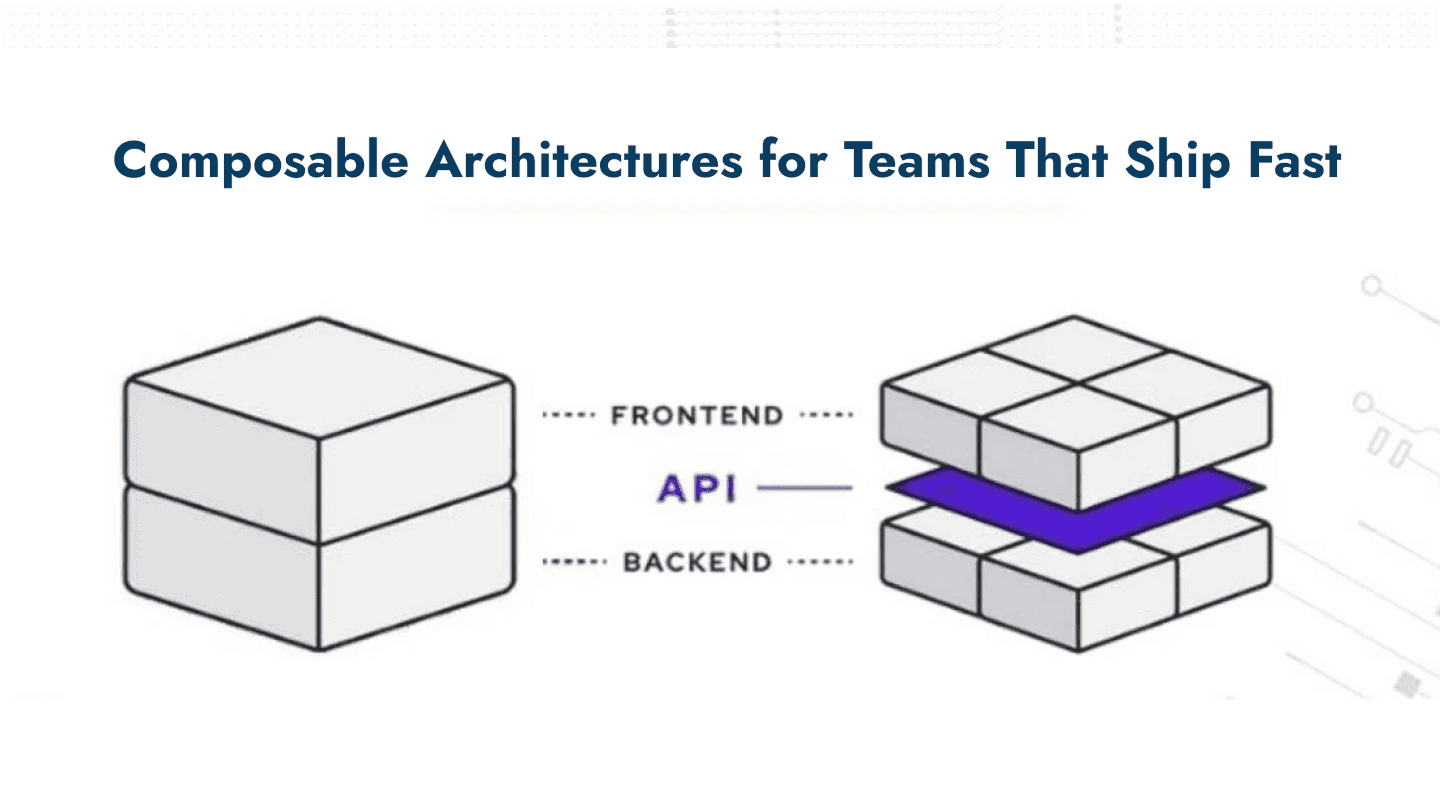
A composable architecture is about creating systems using flexible, modular components that can work together seamlessly. Think of it like building with LEGO blocks; each piece can be developed, deployed, and replaced independently without affecting the rest of the system. This approach treats every element, whether it’s a service, an API, or a workflow, as a building block with clear connections and agreements on how they interact. This setup gives teams the freedom to mix and match, adapt, and grow their applications as business needs and technical requirements evolve, all while feeling confident that changes won’t disrupt the entire system.

Composability relies on a few foundational principles:
Modularity: Each component encapsulates a single responsibility and can be built or modified in isolation.
Interoperability: Components communicate through standardized protocols or APIs.
Replaceability: Any module can be swapped without cascading failures, provided it adheres to shared contracts.
Discoverability: Components are cataloged and documented so teams can reuse existing functionality instead of rebuilding it.
Relationship Between Monoliths and Microservices
In traditional monolithic architectures, all the components are closely integrated, which means updates can be slow and risky. When microservices came along, they offered a solution by allowing teams to deploy services independently. While this brought flexibility, it also led to challenges like operational complexity, complicated networking, duplicated logic, and a lack of unified governance.
Composable architectures strike a balance between these two approaches. They maintain the benefits of modularity without creating fragmented ownership. In this setup, services are decoupled, allowing for greater flexibility, but they still share patterns, APIs, and a cohesive orchestration platform. This way, organizations can enjoy the best of both worlds, moving quickly while keeping things organized.
Core Benefits of Composable Architecture
Agility: Teams can deliver features or fixes quickly without cross-team bottlenecks.
Reuse: Shared, documented components accelerate development and reduce redundancy.
Independent Scaling: Teams scale only what’s needed components, not entire systems.
Composable architectures strike a balance where speed meets stability, allowing teams to deliver products more quickly while maintaining a system that remains coherent, predictable, and easy to adapt over time.
Today, engineering speed has become a key competitive edge. Whether you’re a scrappy startup trying to find your place in the market or a large enterprise looking to modernize outdated systems, the pressure for rapid iteration is unyielding. Customers expect ongoing improvements, and market changes happen faster than traditional setups can keep up with. To keep pace with this demand, teams need systems that can evolve as quickly as their ideas, and that’s where composability shines.
Getting products out the door quickly goes beyond just efficient deployment; it's about creating effective feedback loops. Composable architectures allow for smaller, independent releases that limit the impact of changes. Instead of waiting for a big quarterly release of a monolithic system, teams can work on self-contained components like an authentication service, a pricing engine, or a recommendation module and continuously deliver value. This modular approach turns product delivery into a vibrant stream of innovation rather than a series of dependency-laden hurdles.
Reducing Cognitive Load on Teams
As systems grow larger, they often become more complicated, which can slow everything down. Adopting a composable architecture helps tackle this challenge by allowing teams to take ownership of specific parts of the system that align with their expertise. This way, each team can concentrate on their slice of functionality rather than trying to manage the whole system.
By establishing clear contracts and boundaries, we significantly reduce the need for constant coordination. Developers can focus on their modules without having to navigate through unrelated code. With this reduced mental load, they'll find debugging quicker and experimentation safer, which ultimately leads to smoother collaboration between teams.
Flexibility in Adopting New Tools and Services
Speed isn’t just about how quickly you can build something; it's also about how quickly you can adapt to changes. Composability lets you swap different technologies without having to rewrite everything from scratch. Imagine your team being able to replace a payment API, update a database, or bring in a new AI model by just adjusting one part of the system rather than overhauling the entire setup. This kind of flexibility turns what used to be a headache, architectural changes, into a valuable part of your strategy.
Ultimately, composability isn't just a nice-to-have for modern teams; it's essential for maintaining that speed. It empowers organizations to experiment boldly while keeping their critical systems intact and running smoothly.
Building Blocks of Composable Systems
Composable architectures go beyond simply being a bunch of microservices; they're like interconnected ecosystems where everything has clear agreements, common practices, and a focus on working independently while staying coordinated. Every component, from APIs to how we monitor systems, contributes to finding the right balance between moving quickly and staying safe. For organizations that want to be flexible and adaptable without losing reliability, these elements are essential to build upon.
APIs and Service Contracts
Every composable system begins with a solid interface. Think of APIs as the bridges that allow different components to communicate and work together, acting as the glue that holds various modules and teams in harmony. When service contracts are well-documented, they create a sense of predictability and confidence among developers. They know what to expect, which helps ensure that integrations remain smooth and consistent even as the underlying systems change and grow. Standards like OpenAPI, GraphQL schemas, and AsyncAPI for systems that respond to events promote compatibility and help avoid the common issues that can arise in distributed systems. In this setup, it's the contract rather than the specific implementation that serves as the foundation of the entire system.
Domain-Driven Design Alignment
True composability really reflects how businesses are structured. By aligning our system architecture with domain-driven design (DDD), we can create components that each represent a specific business area, such as authentication, payments, recommendations, and fulfillment. Each of these areas is managed by a team that truly grasps its purpose. This approach allows targeted changes and makes the system easier for both engineers and stakeholders to understand. When business needs evolve, teams can adapt and rearrange these capabilities without rebuilding the entire platform from scratch.
Infrastructure and Platform Layer
Composability really shines when it’s built on a cloud-native foundation. Think of containers, serverless functions, and event-driven systems; they give us the flexibility and scalability to deploy things independently. When we use a shared platform with tools like Kubernetes, AWS Lambda, or Kafka, it creates a consistent environment for everyone. This means teams can get creative and build new things without getting bogged down.
The magic happens with platform abstraction. It allows engineers to concentrate on crafting their logic rather than worrying about the underlying infrastructure. By keeping these aspects separate, we not only speed up delivery but also lighten the operational load. It’s all about making development smoother and more efficient!
Developer Experience Considerations
Creating software quickly relies heavily on how smoothly developers can work while ensuring safety. Composable systems really benefit from a great developer experience (DX). This means having user-friendly templates, clear guidelines, and tools that make best practices the default. Platforms like Backstage or Cortex act as internal hubs where developers can easily find and reuse components, dependencies, and APIs. The aim is to transform governance into a form of support that empowers developers rather than getting in their way.
Observability and Governance Baked In
As systems become increasingly modular, having clear visibility is essential. Each part of the system should be designed to be easily observed, sharing valuable metrics, logs, and traces that can feed into centralized dashboards. Tools and standards like OpenTelemetry help teams keep track of dependencies, performance, and compliance in real time, making governance a vital aspect of the process. It’s important to integrate governance seamlessly from the start, using policy-as-code frameworks that help maintain consistency across teams and different environments.
When we combine these elements, we create something more than just modular systems; we create real momentum. Composable systems transform architecture into a powerful enabler, allowing teams the freedom to innovate, the visibility to manage operations effectively, and the confidence to deliver quickly without compromising the integrity of the business.
Challenges and Pitfalls
Composable architectures offer exciting possibilities for agility and speed, but they aren’t a one-size-fits-all solution. If teams jump in without a solid plan and adequate operational maturity, they might face just as many challenges as they hoped to solve. When organizations prioritize modularity without the right framework, they often end up with a chaotic system that lacks control, leading to more issues than benefits.
Over-Fragmentation: One of the biggest mistakes people make is over-fragmenting their systems by breaking them down into too many tiny components. Although the idea is to foster autonomy, it can actually lead to a situation where everyone ends up dependent on each other in confusing ways. Every little change needs multiple teams to coordinate, deployments can quickly balloon out of control, and troubleshooting turns into a frustrating scavenger hunt. Instead of striving for complete independence, we should focus on making the right elements independent. Composability truly shines when modules are organized around meaningful business areas rather than arbitrary lines of code.
Hidden Coupling: There’s a common pitfall called hidden coupling that many teams encounter. It happens when service interfaces are unclear or not well-managed, leading to invisible dependencies that can trigger widespread issues. For instance, if one team changes a schema or misinterprets a contract, it can send shockwaves through various parts of the system.
To avoid this, it’s important to establish clear contracts, maintain shared governance over versioned APIs, and prioritize automated contract testing and robust backward compatibility. Think of contracts as the glue that keeps all the components of a system together; if they fall apart, the whole structure can start to falter.Scaling Team Practices Alongside Architecture: Just having the right architecture doesn’t automatically make teams agile; it’s really about how those teams work together. As companies embrace a more flexible, composable approach, the roles and responsibilities can start to blur. Teams need to have well-defined roles, clear communication methods, and regular alignment meetings to stay on the same page. Without these elements in place, modular setups can easily fracture into isolated units. Tools like internal developer portals and cross-domain guilds are great for fostering collaboration while still allowing team members to work independently.
Cost and Complexity Trade-Offs: Composability can introduce additional challenges. The more services you have, the more you need to monitor, create pipelines for, and handle infrastructure costs. While adding layers like APIs, gateways, and event buses can boost flexibility, they also make things more complex. As principal engineers, it's crucial to consider these trade-offs carefully. The real question isn’t just “Can we break this down further?” but rather “Should we do that?” The most effective systems aren't necessarily the ones that are the most modular; instead, they tend to be the ones that are easiest to maintain.
Composable architectures thrive not just by being as decentralized as possible, but by having thoughtful, intentional design. When they strike the perfect balance between giving teams the freedom to innovate and keeping everyone aligned with common goals, they can really accelerate progress without losing control. However, if they go too far in trying to decentralize, they might end up overwhelming themselves and falling apart.
Strategies for Teams That Ship Fast Without Breaking
Composable architecture goes beyond being just a technical framework; it's really about how we operate as teams. The key to making it work is in how we organize ourselves, collaborate, and track our progress. High-performing engineering teams achieve a kind of balance not by forcing everyone to be the same, but by promoting speed while still maintaining a solid structure. Here are some strategies that can help teams embrace composability while keeping everything stable and reliable.
Balance Autonomy with Alignment: In composable systems, there's a delicate balance to strike between autonomy and alignment. Each team should have complete ownership of their components from start to finish, but they need to operate within a shared framework that includes standards and agreements. Think of it like having a common language: APIs, data models, and deployment conventions help everyone collaborate without getting in each other's way. The real trick lies in establishing clear expectations while allowing teams the freedom to implement their solutions in their own way, as long as they stay within agreed-upon boundaries.
Golden Paths and Paved Roads: The most effective teams don’t just wing it; they follow established processes that guide their work. Think of these as well-trodden paths; they’re clearly mapped out and rooted in best practices. When teams have these pathways, it doesn't stifle their creativity; instead, it removes the clutter of endless decisions. By using internal platforms that provide templates, reusable components, and easy deployment options, governance transforms into helpful guidance. This way, teams can concentrate on what really matters, delivering value instead of constantly starting from scratch.
Incremental Adoption: Composability doesn’t have to be a drastic change all at once. Many organizations find success by gradually moving from a modular monolith, a system with clear internal boundaries, to fully composable architectures over time. The journey can start with creating well-defined interfaces and slowly extracting services as needed, often driven by performance issues or challenges within the organization. Adopting this change incrementally helps reduce risks and allows teams to get comfortable with a more modular way of working before embracing full autonomy. This approach encourages learning and adaptation along the way.
Metrics That Matter: To ship quickly and avoid issues, teams should keep an eye on some key metrics that help balance speed and stability. Metrics like how often deployments happen, the rate of failed changes, and the average time to recover from issues give a clear picture of delivery health. By combining these with customer-focused indicators like how well features are being adopted, improvements in latency, or less downtime, we can make sure that our fast pace actually leads to meaningful results. Ultimately, these metrics serve as vital feedback loops that keep our innovation on track and accountable.
When autonomy, alignment, and measurement work together, composability becomes more than architecture; it becomes culture. It’s how teams build confidence in speed, and systems evolve without fear of breaking what came before.
Conclusion
Composable architectures empower modern engineering teams to innovate rapidly while maintaining order. By breaking down systems into smaller, interchangeable parts, organizations can adapt and grow without sacrificing reliability. However, it’s important to remember that technology alone won’t ensure success; the right structure and discipline are essential.
The most successful composable systems thrive on well-defined boundaries, smart governance, and teams that are empowered and knowledgeable in their areas. Clear contracts help align efforts, platforms establish necessary standards, and granting teams autonomy drives their speed and creativity. When these elements work together, they foster a rhythm that allows teams to deliver quickly, bounce back from setbacks, and scale effectively.
Ultimately, composability is more than just a technical choice it reflects a leadership mindset. It’s about creating systems and cultures that support sustainable speed, transforming rapid delivery from a potential risk into a long-term competitive edge.
Akava would love to help your organization adapt, evolve and innovate your modernization initiatives. If you’re looking to discuss, strategize or implement any of these processes, reach out to bd@akava.io and reference this post.