
Table of Contents
A practical framework for separating durable AI advantage from marketing language before the wire goes out and for turning what you find into a plan for after close.
Almost every confidential information memorandum that crosses a deal team's desk today tells an AI story. Management teams describe AI-enabled growth, AI-driven margin expansion, and proprietary models that competitors supposedly can't replicate. Data rooms reference automation, machine learning, copilots, and "AI-powered" products throughout the materials. The language is everywhere. The substance behind it is inconsistent and increasingly hard to tell apart from the narrative built around it.
For a private equity firm, that ambiguity cuts two ways. Overpay for a company whose "AI capability" turns out to be a thin wrapper around a public model, and the multiple paid never gets earned back. Underweight a target whose AI advantage is real but buried inside unglamorous technical infrastructure, and a competing bidder captures the upside instead. Both mistakes trace back to the same root cause: diligence that stops at the product demo instead of going into the architecture, the data, and the economics underneath it.
This article lays out a practical framework deal teams, operating partners, and technical advisors can use to pressure-test AI claims with the same rigor applied to any other source of enterprise value and to carry that understanding through to the first hundred days after close.
Why AI Is Difficult to Underwrite
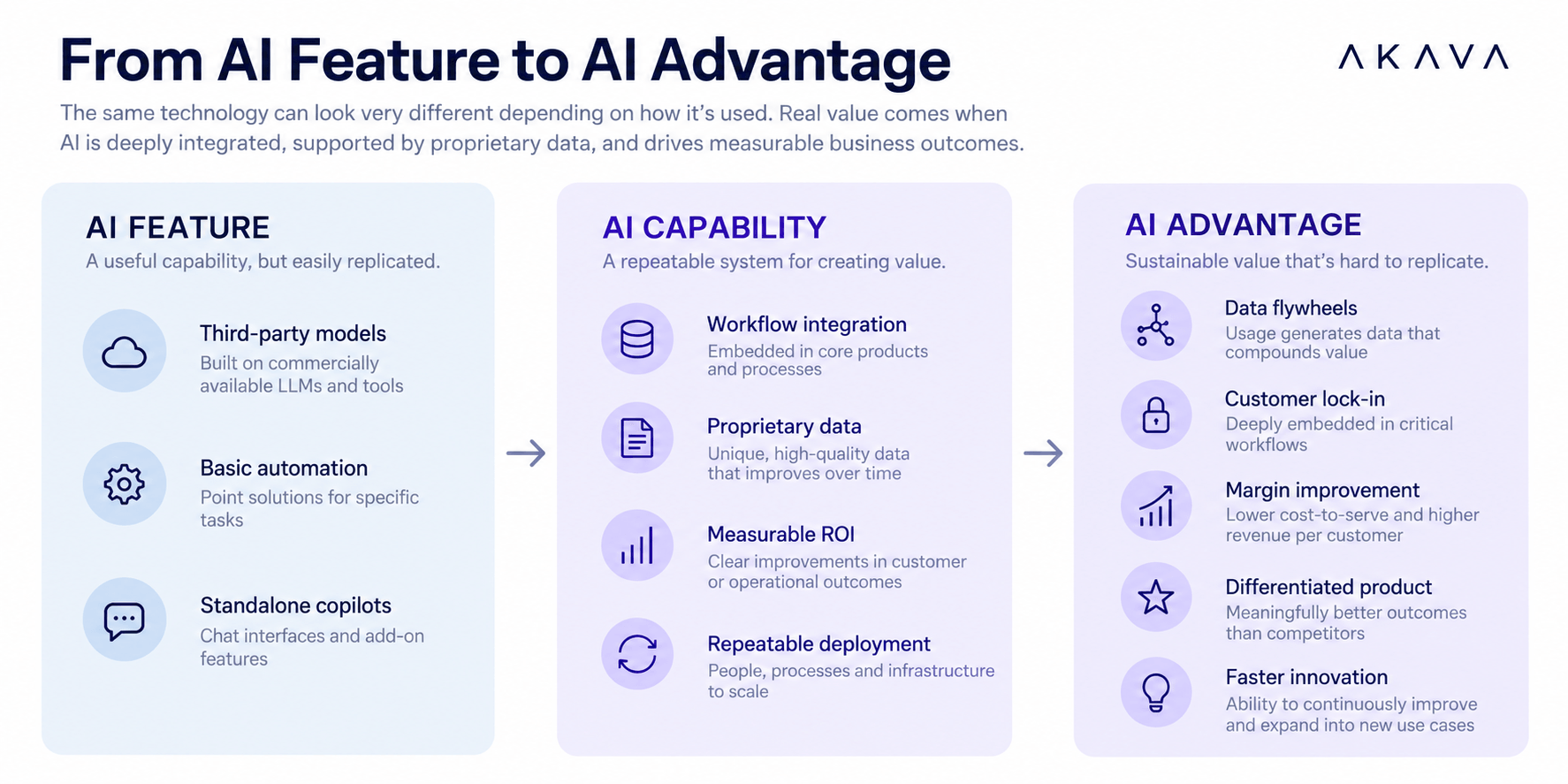
The core problem is that AI has become a label attached to almost anything touching software, which flattens a wide range of very different realities into a single, impressive-sounding word. A company that has spent three years building a proprietary model trained on exclusive operational data and a company that added a chatbot to its support page last quarter can both describe themselves, accurately, as "AI-driven." Only one of those is a defensible asset.
Three distinctions matter more than the word "AI" itself:
- Adoption: the company uses AI tools somewhere in its stack, typically off-the-shelf models or vendor products.
- Capability: the company has built real technical competence: custom models, fine-tuning pipelines, evaluation infrastructure, or ML engineering depth.
- Moat: that capability compounds over time through data, workflow lock-in, or distribution in a way competitors cannot quickly copy.
Most CIMs blur these three together. Sell-side materials are, understandably, built to maximize the multiple, and AI is currently the fastest way to do that. The risk for a deal team is treating adoption as if it were a moat, and paying a capability-and-moat premium for what is, underneath the surface, a feature built on someone else's model with someone else's roadmap. Getting this right requires diligence that goes past the demo and into the architecture, the data rights, and the unit economics the layer where buzzwords stop being useful, and evidence starts.
Where Real AI Value Actually Lives
Durable AI value tends to share a small set of characteristics, regardless of industry. Deal teams that know what to look for can usually tell within a few conversations whether they're looking at a genuine asset or a demo built for the process.
- Proprietary data and feedback loops: The strongest signal is a data asset competitors cannot easily obtain, built from years of customer interactions, operational telemetry, or transaction history combined with a loop where the model's output improves the product, which in turn generates more of the data that improves the model.
- Workflow embedding, not bolt-on features: AI that sits inside a core, revenue-critical workflow underwriting, routing, pricing, fraud detection is structurally harder to rip out than a chatbot layered on top of an existing product. Ask where in the customer's day the AI actually operates, not just where it's mentioned in the pitch deck.
- Measurable business outcomes: Genuine value shows up in numbers: cycle-time reduction, error-rate improvement, gross margin expansion, or revenue per employee, not in adjectives like "transformative" or "cutting-edge."
- Distribution and stickiness: AI capability compounds when it's tied to a distribution advantage: an existing customer base, a data network effect, or switching costs that make it costly for a customer to walk away.
- Repeatable internal capability: The most durable signal of all is organizational; can this team ship a second AI feature as fast as it shipped the first, or was the flagship capability a one-off built by a departing founder or an outside consultancy?
None of these requires a company to have built a large language model from scratch very few should. But they do require evidence that AI is doing structural work inside the business, rather than dressing up a story for the process.
A Diligence Framework for Deal Teams
Once a team has calibrated on what genuine AI value looks like, the diligence itself breaks down into five reviews. None of them is exotic; they're the standard diligence disciplines, pointed specifically at the AI claims in the CIM.
- Product review: Identify exactly which models are in production, where they sit in the product, and why that model was chosen over alternatives. A team that can't clearly explain its model choices or that treats the model as a black box purchased from a vendor is signaling limited internal capability.
- Data review: Examine data quality, exclusivity, labeling processes, and critically the legal rights the company actually holds to the data it's using. Ambiguous data provenance or customer contracts silent on AI usage rights are common and expensive surprises found late in diligence.
- Economics review: Inference is a real, often underestimated cost. Build unit economics by use case: cost per inference, gross margin after model costs, and ROI for each AI-enabled feature. Several "AI-driven" products carry negative contribution margin once true compute costs are allocated correctly.
- Technical review: Assess architecture, vendor dependency, and scalability. Heavy dependence on a single foundation model provider without abstraction is a real risk: pricing changes, deprecations, and rate limits can materially change unit economics overnight. Security and data governance controls need the same scrutiny given to any sensitive data infrastructure.
- Talent review: Evaluate leadership's technical fluency, the depth of the ML and engineering bench beyond one or two key individuals, and the organization's track record of shipping AI capability on a predictable cadence. Key-person risk is especially acute in AI teams, where a small number of people often hold disproportionate institutional knowledge.
Run together, these five reviews tend to sort targets quickly into three buckets: companies with genuine, defensible AI capability; companies with real but immature capability that needs investment; and companies where AI is primarily a narrative layered on top of an otherwise ordinary software business. Each bucket implies a different view on price and a different post-close plan.
The Post-Close Value Creation Playbook
Diligence findings only create value if they turn into an execution plan the moment the deal closes. The firms that generate the strongest returns from AI-enabled targets treat diligence output as the first draft of a 100-day plan, not a checkbox closed at signing.
- Build an AI roadmap tied to EBITDA and growth levers: Every initiative on the roadmap should map to a specific value driver cost reduction, margin expansion, revenue growth, or multiple expansion at exit rather than existing as a general technology initiative.
- Rationalize vendors, tools, and infrastructure spend: Portfolio companies frequently carry redundant AI tooling and unmonitored inference spend accumulated during rapid, less disciplined growth. This is often one of the fastest, lowest-risk sources of margin improvement post-close.
- Establish governance, risk, and compliance controls: Enterprise customers, regulators, and future acquirers increasingly expect data privacy, model risk management, and responsible-use policies. Retrofitting governance is far more expensive than building it in from day one.
- Create a cross-functional AI operating model: The strongest performers pair technical talent with product and commercial teams, so AI initiatives are prioritized against business outcomes rather than developed in isolation by an engineering team.
The best returns in this category rarely come from spotting AI potential before close. They come from operationalizing it methodically after close, turning a diligence thesis into shipped capability, tracked against the metrics that drive the eventual exit.
Conclusion
AI has become the standard narrative in almost every technology-related deal process, which means that the narrative itself holds less value in terms of due diligence. What truly differentiates a genuine asset from a promising pitch is concrete evidence. This includes proprietary data loops, integrated workflows, defensible economics, sound architecture, and an organization capable of replicating its initial successes. A structured framework encompassing product, data, economics, technical aspects, and talent review provides deal teams with a systematic method to identify this evidence. Furthermore, a well-crafted hundred-day plan based on this evidence is what ultimately transforms a well-researched thesis into tangible returns.
Akava would love to help your organization adapt, evolve and innovate your modernization initiatives. If you’re looking to discuss, strategize or implement any of these processes, reach out to bd@akava.io and reference this post.