Table of Contents
As companies seek to gain a competitive edge, acquire new capabilities, or expand their market share, the importance of technical due diligence cannot be overstated. Among the various aspects of technical due diligence, architecture review stands out as a critical component that often determines the success or failure of a deal. This comprehensive guide will explore the crucial role of architecture review in technical due diligence, providing insights into its benefits, best practices, and common pitfalls.
"In the world of digital business, the architecture review is the equivalent of the home inspection before purchasing a house. It's a critical step in understanding the quality, risks, and potential of the technology asset you're acquiring." - GartnerWhat is Architecture Review?
An architecture review is a thorough and systematic evaluation of a software system's structure, design, and overall quality. It involves a deep dive into the system's components, interfaces, interactions, and underlying technologies to assess its strengths, weaknesses, and potential risks. The goal of an architecture review is to provide a clear and objective understanding of a system's capabilities, scalability, maintainability, security, and alignment with business objectives.
Pro-Tip: When conducting an architecture review, it's essential to look beyond the surface-level features and dive deep into the system's underlying structure and design. This holistic approach ensures that you uncover any hidden risks or opportunities that could impact the success of your investment.During an architecture review, a team of experienced engineers and technical experts carefully examine various aspects of the system, including:
- High-level system architecture: This includes analyzing the overall system design, component interactions, and data flow to ensure that the architecture is sound, efficient, and aligned with industry best practices.
- Technology stack: The review team assesses the technologies used in the system, including programming languages, frameworks, libraries, and databases, to ensure that they are up-to-date, widely supported, and appropriate for the system's requirements.
- Scalability and performance: The team evaluates the system's ability to handle increased traffic, data volumes, and user loads, identifying any bottlenecks or performance issues that could hinder future growth.
- Security and compliance: The architecture review includes a thorough assessment of the system's security measures, identifying any vulnerabilities or weaknesses that could expose sensitive data or compromise the system's integrity. The team also ensures that the system complies with relevant industry standards and regulations.
- Maintainability and extensibility: The review team examines the codebase structure, documentation, and design patterns to determine how easily the system can be maintained, updated, and extended over time.
By conducting a comprehensive architecture review, organizations can gain valuable insights into the quality and potential of a technology asset, enabling them to make informed decisions during the due diligence process.
The Importance of Architecture Review in Technical Due Diligence
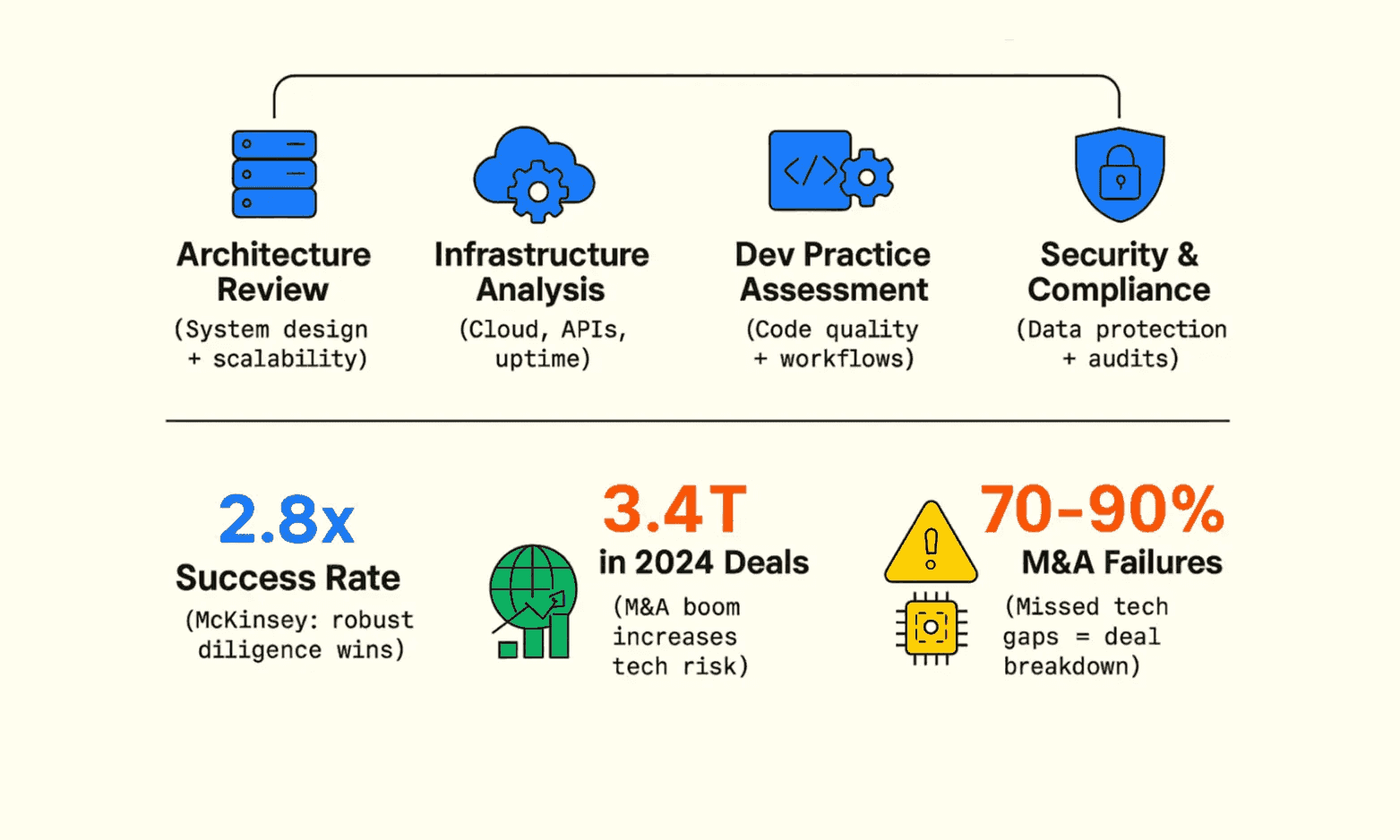
In the context of technical due diligence, architecture review plays a pivotal role in assessing the value, risks, and potential of a technology asset.
When an organization considers acquiring or investing in a technology company, it is essential to look beyond the surface-level metrics and delve into the underlying architecture that powers the company's products or services.
A well-designed and robust architecture is the foundation upon which a technology company's success is built. It enables the company to innovate, scale, and adapt to changing market demands. On the other hand, a poorly designed or outdated architecture can lead to a host of problems, including performance issues, security vulnerabilities, and difficulty in maintaining or extending the system.
"Architecture review is not just a technical exercise; it's a strategic imperative. It helps organizations make informed decisions, mitigate risks, and maximize the value of their technology investments in an increasingly competitive landscape." - DeloitteBy incorporating architecture review into the technical due diligence process, organizations can:
- Identify potential risks and red flags early in the process, allowing them to make informed decisions about whether to proceed with the deal or negotiate better terms.
- Assess the scalability and future-proofing of the technology asset, ensuring that it can support the organization's long-term growth and objectives.
- Evaluate the maintainability and extensibility of the system, which can have significant implications for post-acquisition integration and future development efforts.
- Uncover opportunities for improvement and value creation, such as identifying areas where the system can be optimized, refactored, or modernized to unlock additional value.
- Provide a more accurate valuation of the technology asset, taking into account the quality and potential of the underlying architecture.
In short, architecture review is a critical tool for organizations to mitigate risks, make informed investment decisions, and maximize the value of their technology acquisitions.
Best Practices for Conducting an Effective Architecture Review
To ensure a successful and valuable architecture review, organizations should follow these best practices:
- Assemble a skilled and diverse review team: The architecture review team should consist of experienced engineers, architects, and technical experts with a deep understanding of software design principles, industry best practices, and the relevant technologies. It is also beneficial to include team members with different specialities, such as security, performance optimization, and data management, to provide a well-rounded perspective.
- Define clear objectives and scope: Before beginning the review, clearly define the objectives and scope of the architecture review. This includes identifying the specific components, systems, or technologies to be evaluated, as well as the desired outcomes and deliverables of the review process.
- Gather and analyze relevant documentation: Collect and review all available documentation related to the system's architecture, including design documents, API specifications, data models, and infrastructure diagrams. This documentation provides a foundation for understanding the system's structure and design decisions.
- Conduct thorough code and design reviews: Dive deep into the codebase and analyze the system's design at various levels, from high-level component interactions to low-level implementation details. Look for code quality issues, design anti-patterns, and potential performance bottlenecks.
- Interview key technical stakeholders: Engage with the technology company's key technical stakeholders, such as architects, lead developers, and product managers, to gain insights into the system's history, design decisions, challenges, and future roadmap. These interviews provide valuable context and help uncover any undocumented knowledge or assumptions.
- Perform hands-on testing and analysis: Conduct hands-on testing and analysis of the system to validate the findings from the code and design reviews. This may include performance testing, security assessments, and scalability evaluations to identify any potential issues or limitations.
- Provide clear and actionable recommendations: Based on the findings of the architecture review, provide clear and actionable recommendations for improvements, optimizations, and risk mitigation. Prioritize the recommendations based on their impact and feasibility, and provide guidance on how to implement them effectively.
- Communicate findings and collaborate with stakeholders: As Accenture, a multinational professional services company, emphasizes, communicate the results of the architecture review to all relevant stakeholders, including the acquisition team, technical leadership, and executive decision-makers. Collaborate with the technology company's team to discuss the findings, address any concerns, and develop a plan for addressing the identified issues or opportunities.
By following these best practices, organizations can conduct a thorough and effective architecture review that provides valuable insights and guides informed decision-making during the technical due diligence process.
Common Architecture Red Flags and Risk Factors
During an architecture review, the review team should be on the lookout for common red flags and risk factors that may indicate potential issues or challenges with the system's architecture. Some of these red flags include:
- Monolithic architecture: A monolithic architecture, where all components are tightly coupled and interdependent, can make the system difficult to scale, maintain, and evolve over time. It can also increase the risk of system-wide failures and make it harder to implement changes or updates.
- Lack of modularity and separation of concerns: A system that lacks clear modularity and separation of concerns can be more complex, harder to understand, and more challenging to maintain. This can lead to increased technical debt, reduced agility, and difficulty in scaling or extending the system.
- Outdated or unsupported technologies: The use of outdated or unsupported technologies can pose significant risks to the system's security, reliability, and maintainability. It can also make it harder to find skilled developers, increase the cost of maintenance, and limit the system's ability to integrate with modern tools and platforms.
- Poor documentation and knowledge sharing: Inadequate or outdated documentation can make it difficult for new team members to understand the system's architecture, design decisions, and implementation details. This can lead to increased reliance on key individuals, reduced maintainability, and a higher risk of knowledge loss.
- Inadequate testing and quality assurance: A lack of comprehensive testing and quality assurance processes can lead to increased bugs, performance issues, and security vulnerabilities. It can also make it harder to catch and address problems early in the development cycle, leading to higher costs and longer time-to-market.
- Scalability and performance limitations: Systems that are not designed to scale or handle increasing loads can experience performance degradation, increased latency, and even complete failures as usage grows. This can limit the system's ability to support business growth and negatively impact user experience.
- Security vulnerabilities and compliance issues: Inadequate security measures, such as lack of encryption, insecure data storage, or weak access controls, can expose the system to potential breaches, data loss, and reputational damage. Non-compliance with relevant industry standards and regulations can also result in legal and financial consequences.
Pro-Tip: When evaluating a system's architecture, pay close attention to scalability, security, and maintainability. These factors are critical to ensuring that the technology asset can support your organization's long-term growth and evolving needs.By identifying these red flags and risk factors during the architecture review, organizations can make informed decisions about the potential challenges and costs associated with acquiring or investing in a particular technology asset. This knowledge can help them negotiate better terms, plan for necessary improvements or remediations, and ultimately maximize the value of their technology investments.
Wrap-Up
Architecture review has emerged as a critical component of technical due diligence. By providing a deep and comprehensive evaluation of a software system's structure, design, and quality, architecture review enables organizations to make informed decisions, mitigate risks, and unlock the full potential of their technology investments.
"In the fast-paced world of technology, architecture review has become a critical differentiator. Organizations that prioritize and excel at this crucial aspect of technical due diligence will be better positioned to make successful acquisitions, drive innovation, and lead the way in their industries." - Bain & Co.Through a combination of skilled review teams, well-defined objectives, thorough analysis, and clear communication, organizations can conduct effective architecture reviews that provide valuable insights and actionable recommendations. By identifying strengths, weaknesses, and potential risks early in the due diligence process, architecture review helps organizations navigate the complexities of technology acquisitions and investments with confidence and clarity.
As technology continues to drive business growth and innovation, the importance of architecture review in technical due diligence will only continue to grow. By embracing best practices, staying vigilant for common red flags, and leveraging the expertise of skilled professionals, organizations can position themselves for success in the fast-paced world of technology M&A and investment.
Is your target's software architecture built to last or a house of cards waiting to collapse? Don't leave it to chance. Contact patrick@akava.io for a comprehensive architecture review during technical due diligence. Let our experts help you identify risks, unlock potential, and make informed decisions for your technology investment.