
Table of Contents
Which AI orchestration framework should you build on, and what does your answer say about the kind of AI system you're actually building?
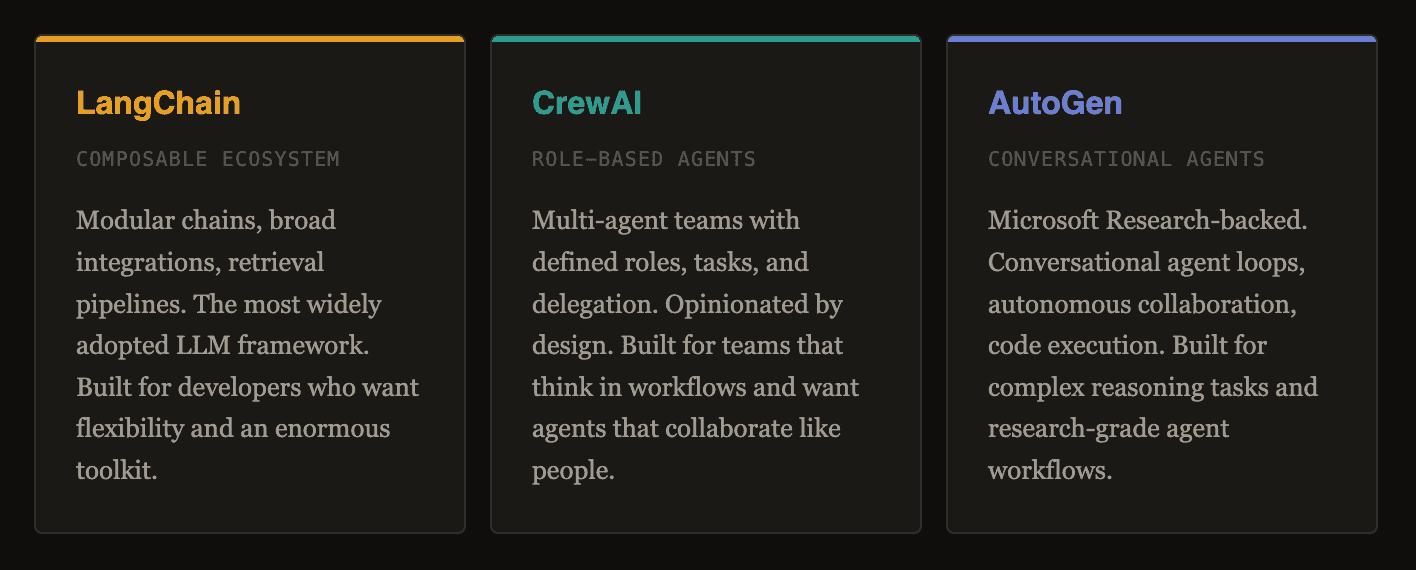
The framework question is really two questions compressed into one: what kind of AI system are you building, and how much of that system do you want the framework to decide for you?Each of these three frameworks(LangChain vs. CrewAI vs. AutoGen) represents a different answer to the second question.
LangChain says: Here are components; build what you want.
CrewAI says: Here is a model for how agents should collaborate. Fit your problem to it.
AutoGen says: Here is a pattern for autonomous agent interaction; push it as far as it goes.
None of these answers is wrong, but they suit different teams, different products, and different stages of development.
This article breaks down the strengths, tradeoffs, and ideal use cases for each framework, while offering a practical lens for deciding where to place your bets in a fast-moving ecosystem.
Why AI Framework Choice Matters Now
A year ago, most teams were still at the "single LLM call" stage: one prompt, one response, ship it. The tooling around that was thin on purpose. The call to an API was simple enough not to need abstraction.
Production AI systems in 2026 are not that. They involve retrieval pipelines, tool use, multi-step reasoning, parallel agent execution, state management across turns, fallback handling, observability, and cost routing. That complexity needs to live somewhere. The question is whether it lives in a framework you adopted, a framework you built, or something in between.
The risk of the wrong choice is real. Frameworks impose abstractions, and abstractions have costs: they are harder to debug than code you wrote, they shape what's easy to do and what isn't, and they can become a liability when the underlying models change faster than the framework maintainers update their assumptions.
The lock-in question
Framework lock-in in AI is different from database lock-in. It's not just that migration is expensive, it's that frameworks accumulate in product logic. A LangChain chain or a CrewAI crew ends up in your application code, your prompt templates, and your eval scripts. The coupling is diffuse, which makes it harder to see and harder to unwind.That said, building from scratch is also a bet. Teams that avoid all frameworks spend significant engineering time on solved problems, retry logic, tool dispatch, context windowing, and output parsing. The question isn't "framework or no framework" but "which framework's opinions align with the system I'm building."
Core philosophies comparison
Dimension | LangChain | CrewAI | AutoGen |
Core abstraction | Chains & components | Agents with roles & tasks | Conversing agent pairs |
Design philosophy | Composable, flexible, ecosystem-first | Opinionated, workflow-first | Conversational, research-oriented |
Primary use case | RAG pipelines, integrations, LLM apps | Multi-agent teams, task delegation | Autonomous agents, code generation |
Mental model | A pipeline with steps | A team with roles | A conversation between agents |
Backed by | LangChain Inc. (VC-backed) | Independent / community | Microsoft Research |
Maturity signal | Largest community, most integrations | Fast-growing, newer | Research-grade, enterprise push |
Developer experience in practice
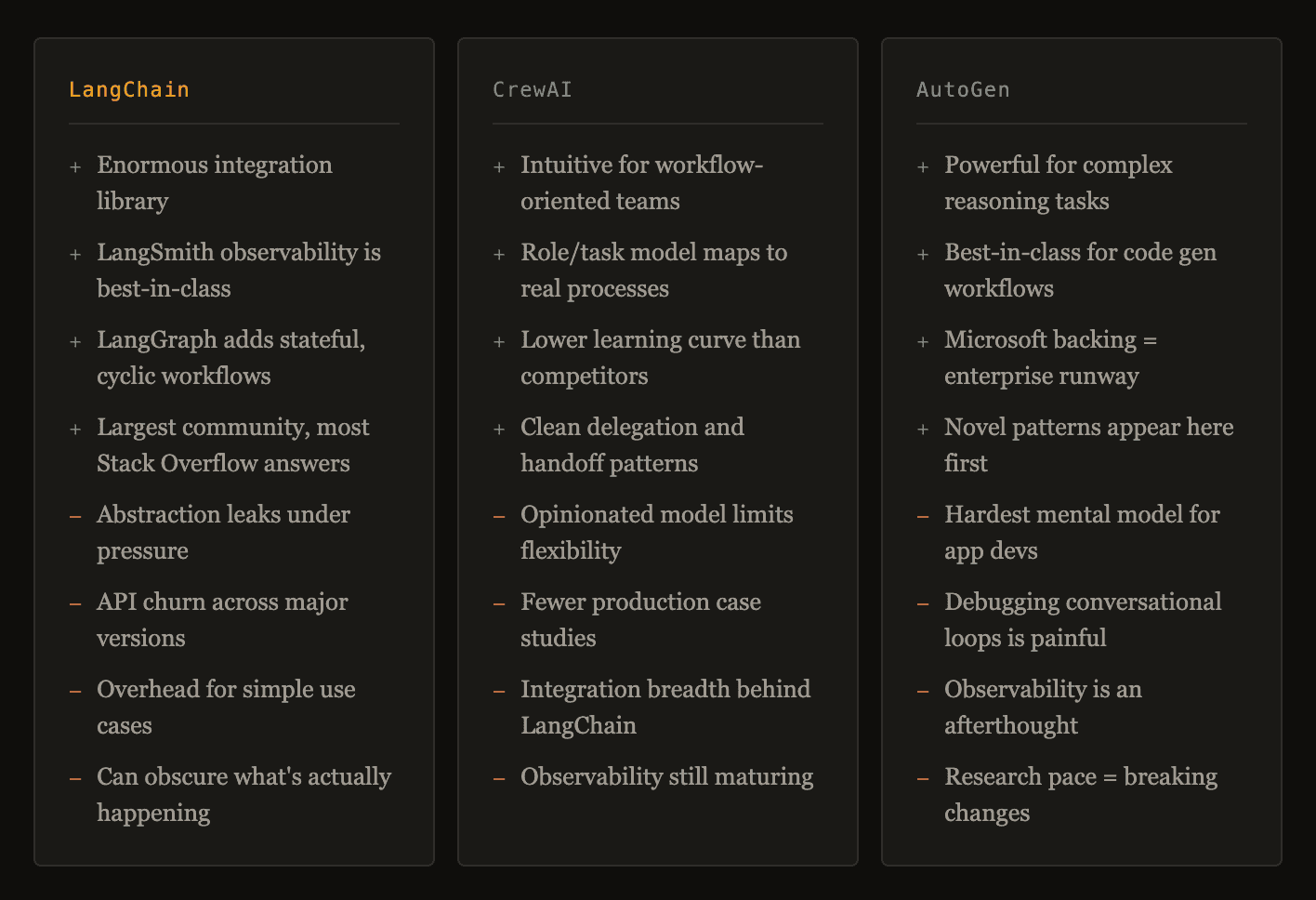
LangChain has the deepest ecosystem, over 600 integrations, LangSmith for observability, and LangGraph for stateful workflows. The downside is that the abstraction layer has historically been leaky. When things go wrong (and in LLM systems, they do), you often end up debugging the framework as much as your own code. The v0.1 to v0.2 migration frustrated many teams; the LCEL rewrite introduced new patterns mid-production. The community is enormous, which helps with debugging, but the surface area is large.
CrewAI has a notably lower learning curve for developers thinking in workflow terms. If your mental model is "I have a researcher agent, an analyst agent, and a writer agent, and they hand work to each other," CrewAI maps to that almost directly. The tradeoff is that its opinions become constraints when your workflow doesn't fit the crew/task/agent model cleanly, and you find yourself fighting the abstraction. It's also younger, which means fewer production case studies and rougher edges in edge cases.
AutoGen is the most different in character. Its core pattern, two or more agents having a conversation to solve a problem, is powerful for complex reasoning tasks but unusual for application developers to reason about. It excels at code generation and execution workflows. It is the most research-oriented of the three, which means it's often the first to implement novel patterns and the last to polish them for production use.
"The right framework is the one whose opinions you agree with. Every other framework will feel like friction."Community and production readiness
Signal | LangChain | CrewAI | AutoGen |
GitHub stars (approx.) | 90k+ | 25k+ | 35k+ |
Production deployments | High | Medium | Medium |
Debugging ergonomics | Medium | High | Low |
Enterprise support | LangSmith / LangChain Inc. | Enterprise tier available | Microsoft backing |
Observability built-in | LangSmith (first-class) | Partial, improving | Limited, bring your own |
Breaking changes risk | High historical track record | Moderate (younger) | High (research-paced) |
Real-world tradeoffs for engineering teams
The observability gap
This deserves special attention because it's where most framework decisions look different in production than in prototyping. LangChain has a significant advantage here LangSmith provides tracing, evaluation, and monitoring as a first-class product. When your LangChain chain behaves unexpectedly in production, you have a place to look.
CrewAI and AutoGen both require you to bring your own observability, or bolt on third-party tooling (Helicone, Arize, custom OpenTelemetry spans). That's not fatal, but it means more setup work and more surface area to maintain. For teams that haven't yet built observability into their AI stack, this gap is larger than it appears.
When frameworks make things worse
There is a category of AI use cases where all three frameworks add more complexity than they remove: single-turn, low-complexity tasks with tight latency requirements. If you're classifying support tickets, summarizing documents, or extracting structured data from text, you probably don't need orchestration, agent loops, or a retrieval pipeline. A direct API call with a well-crafted prompt, a retry wrapper, and basic logging is faster to build, easier to debug, and cheaper to run. Reaching for a framework in this case is the AI equivalent of using Kubernetes to deploy a static site.
The simplest option worth naming
For many production AI tasks, the right stack is: Anthropic or OpenAI SDK + a prompt registry (even just version-controlled markdown files) + structured output parsing + a basic observability wrapper. This isn't a framework it's about 400 lines of glue code. It's debuggable, fast, and portable. Don't let the existence of three sophisticated frameworks make you forget this option exists.Where to bet: strategic guidance
Decision framework: which to pick when
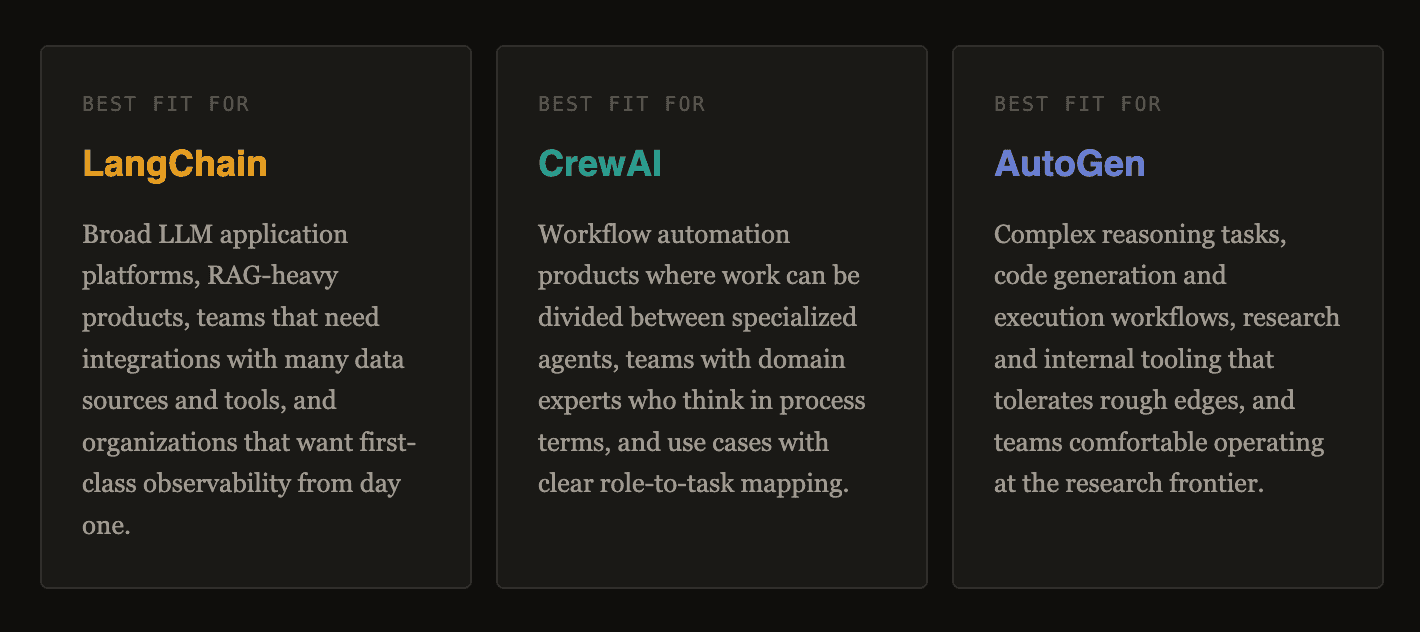
Building a RAG product | LangChain.The retrieval primitives, vector store integrations, and document loaders are mature. LangGraph handles the stateful parts. LangSmith gives you observability without extra setup. |
Automating a multi-step workflow | CrewAI if the workflow maps cleanly to roles and task handoffs. |
Code generation / dev tools | AutoGen is strongest here. The conversational agent loop plus code execution sandbox is purpose-built for this pattern. Expect rough edges; budget for debugging time. |
Simple classification or extraction | None of the above. Direct SDK call, structured output parsing, basic retry logic. Don't introduce a framework for a use case that doesn't need one. |
Enterprise / regulated industry | LangChain for its observability story and community. |
Prototyping novel agent patterns | AutoGen first, it's where new patterns appear earliest. Expect to rewrite for production in a more stable framework or a custom stack once you've validated the approach. |
"Bet on principles and portability, not logos. The framework you're using in two years probably doesn't exist yet."The AI infrastructure space is moving fast enough that framework dominance is not guaranteed. LangChain's rapid API changes have already pushed some teams to alternatives. AutoGen's Microsoft backing provides a runway but doesn't guarantee community momentum. CrewAI's opinionated model could become a constraint as agent patterns evolve.
What endures across frameworks is the underlying architecture: clear separation between your business logic and the orchestration layer, evaluation infrastructure that runs independently of the framework, observability that works regardless of which LLM you're calling, and prompt management that isn't tangled into framework-specific abstractions.
The teams that will be in the best position in 2027 are not the ones who picked the right framework. They're the ones who built their AI systems with enough abstraction that they can swap the framework when the landscape changes, and they will.
Akava would love to help your organization adapt, evolve and innovate your modernization initiatives. If you’re looking to discuss, strategize or implement any of these processes, reach out to bd@akava.io and reference this post.