
Table of Contents
An examination of what NoOps actually promises, where it is real today, and why operations is being redesigned rather than removed.
Few ideas in software delivery are as appealing as the one that operations might simply go away. No servers to patch, no pipelines to babysit, no pager at three in the morning. Developers write code, the platform does the rest, and the entire discipline of running software quietly dissolves into automation. Serverless platforms, managed services, infrastructure as code, and now AI-driven remediation all seem to point in the same direction. For engineering leaders weighing headcount, cost, and delivery speed, the question is hard to avoid: Is NoOps the future, or is it the next narrative that outruns reality?
The honest answer is both, depending on what the term is taken to mean. If NoOps means no operational work, it is a myth. If it means no operational work that a human should be doing by hand, it is not only plausible but already underway. The difference between those two readings determines whether an organization invests wisely or repeats a familiar pattern of overpromising, underdelivering, and dismantling capabilities it later has to rebuild.
This article explores what NoOps actually promises, where it already works, where it breaks down, and how leaders can move toward it without betting the business on the slogan.
What NoOps Actually Promises
The term is applied loosely, which is the first source of confusion. Some use it to describe a specific architecture, such as fully managed, serverless workloads. Others use it as shorthand for a cultural goal: automation so complete that operations becomes invisible. Still others use it as a headcount target. These are very different claims.
A spectrum, not a switch
NoOps is best understood as the far end of a continuum rather than a destination that is either reached or not. Each step along it removes a category of manual work from human hands.
| Traditional Ops | DevOps | Platform Engineering | NoOps (aspirational) | |
|---|---|---|---|---|
| Who operates the system | A dedicated operations team | Product teams, with shared tooling | A platform team provides self-service capabilities | The platform and automation, with humans by exception |
| Provisioning | Ticket-driven | Scripted and partially automated | Self-service, standardized | Declarative and fully automated |
| Incident response | Manual, escalation-based | Shared on-call | Runbooks and automated mitigations | Automated detection and remediation |
| Primary human effort | Running systems | Building and running systems | Building the platform | Defining policy, intent, and guardrails |
The movement from left to right does not eliminate work. It changes what kind of work humans do and where it happens.
The core claim
Stripped of marketing, the NoOps proposition has three parts: infrastructure is abstracted away from application teams, routine operational tasks are performed by software, and failures are detected and corrected without human intervention. Each part is real in some contexts. None is universal.
Why the Dream Is So Compelling
NoOps is not appealing because leaders are naive. It is appealing because the pressures it answers are real and growing.
Toil is expensive and demoralizing
Repetitive, manual, automatable work is the most corrosive form of operational effort. It scales linearly with the size of the system, produces no lasting value, and wears down the people doing it. Any approach that removes toil is, in principle, a better use of talented engineers.
Cognitive load has become the bottleneck
Modern stacks ask developers to understand containers, orchestration, networking, identity, observability, and cloud cost models on top of their actual product domain. The promise of NoOps is that application teams can focus on business logic and let the platform absorb the rest.
The building blocks have matured
Several technologies make the vision more credible than it was a decade ago:
- Managed and serverless services that remove entire layers of infrastructure responsibility
- Infrastructure as code and GitOps that make environments reproducible and auditable
- Autoscaling and self-healing orchestration that handle common failure and load patterns automatically
- AIOps and automated remediation that correlate signals, suggest causes, and increasingly act on them
Taken together, these make it possible to run workloads at a level of automation that would have seemed implausible not long ago.
Where NoOps Is Already Real
It would be a mistake to dismiss the idea because the extreme version is unrealistic. In specific, well-bounded contexts, something very close to NoOps already exists.
Stateless, event-driven workloads
Functions and managed event processing remove patching, capacity planning, and server management from the team's responsibilities. For workloads with predictable shapes, operational effort can be very low.
Commodity capabilities consumed as services
Databases, queues, object storage, identity, and CDN layers are rarely worth operating in-house. Consuming them as managed services is an unambiguous win, and few organizations would argue for going back.
Automated remediation of known failure modes
Restarting unhealthy instances, rolling back a bad deployment when error rates spike, and scaling on demand are now routine. The pattern is consistent: automation handles the failures that are well understood and repeatable.
That last point is the key to the entire debate. Automation is excellent at the known. Operations, in practice, is largely about the unknown.
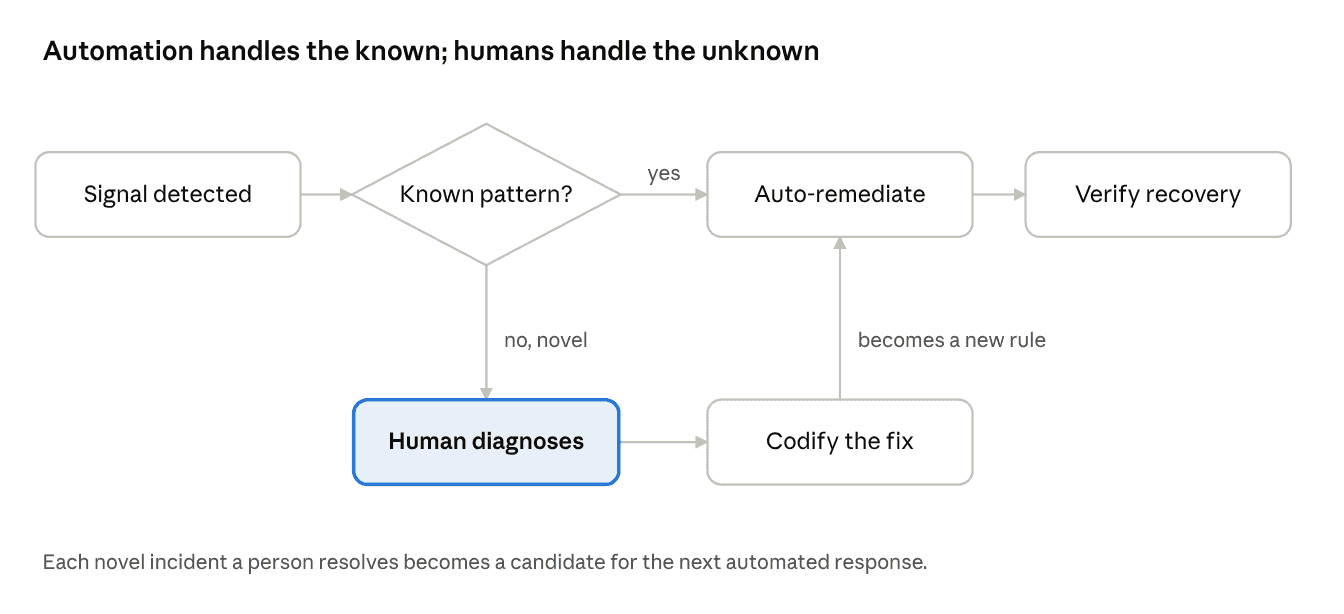
remediation loop · 1 decision, 1 feedback path
Known failures follow the top row and are fixed by software. Novel ones drop to a person, and the fix is codified so the same failure is automated next time.
Why Operations Does Not Disappear
The strongest argument against NoOps is not technical pessimism. It is a structural observation: complexity does not vanish when it is abstracted. It moves.
Complexity is relocated, not removed
When a team adopts a managed service, it stops operating the underlying machines. It starts operating a relationship with a vendor: understanding limits, quotas, failure semantics, pricing behavior, and exit costs. When a team adopts serverless, it stops managing servers. It starts managing cold starts, concurrency limits, distributed tracing across dozens of functions, and the cost of invisible scale. The work changes shape, and the skills required change with it.
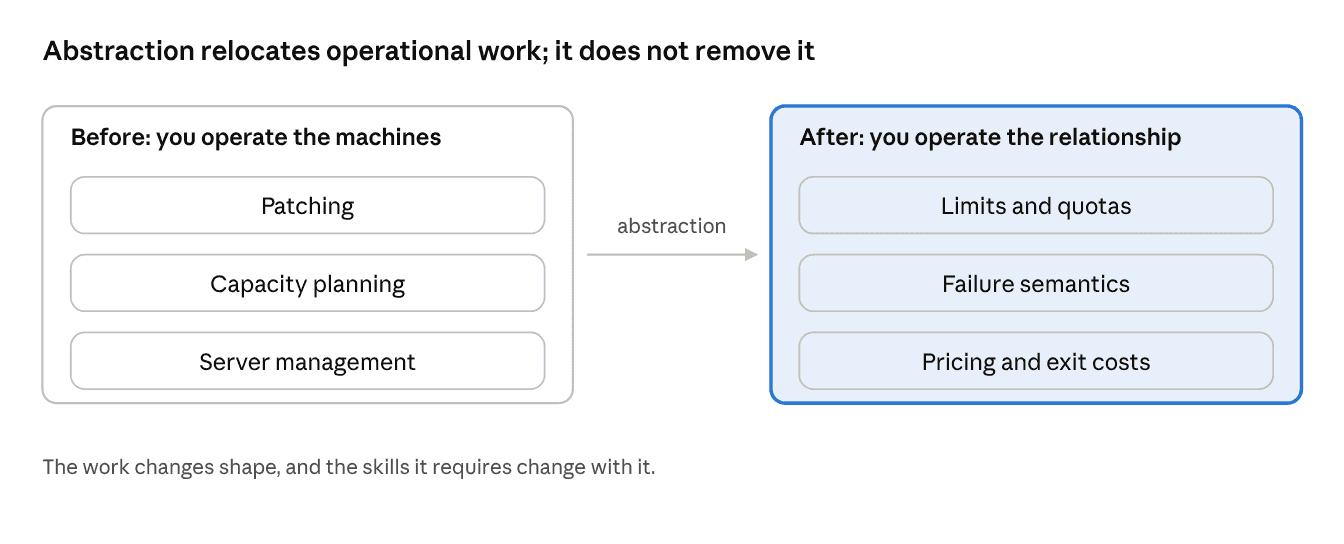
before and after a managed service · 3 vs 3 burdens
The machines stop being the team's problem. The vendor relationship becomes it.
Responsibility cannot be outsourced
A provider can run the infrastructure. It cannot own the customer's outcome. Availability targets, data protection, regulatory compliance, and incident accountability remain with the organization that offers the service. Under the shared responsibility model, the line moves, but it never disappears.
Novel failures still need human judgment
Automated remediation handles patterns it has seen. Real incidents often involve interactions no one anticipated: a dependency behaving differently under load, a configuration change that is valid in isolation but harmful in combination, a cascading failure across services. Diagnosing these requires system understanding and judgment, which are operational skills by another name.
Automation introduces its own failure modes
A system that acts on its own can also fail on its own, faster and at larger scale than a human could. Misconfigured auto-remediation can amplify an incident. Runaway autoscaling can produce a financial incident instead of a technical one. As more decisions are delegated to software, including AI agents, the blast radius of a bad decision grows unless guardrails are designed deliberately.
Cost, security, and compliance remain continuous disciplines
Cost optimization, vulnerability management, access governance, and audit readiness do not happen once. They are ongoing practices, and they require people who understand both the technology and the business.
Hype or Inevitable? A Fair Assessment
A useful way to cut through the debate is to separate the claims being made and evaluate each on its merits.
| Claim | Verdict | Reasoning |
|---|---|---|
| Manual, repetitive operations work will keep shrinking | Inevitable | Automation economics are one-directional; toil is a poor use of skilled people |
| Developers will operate less infrastructure directly | Largely inevitable | Abstraction and managed services continue to absorb undifferentiated work |
| Operations roles will change significantly | Inevitable | The center of gravity moves from running systems to designing platforms, policy, and reliability |
| Systems will heal themselves without humans | Partially true | Holds for known, repeatable failures; not for novel ones |
| Operations as a discipline will disappear | Hype | Responsibility, judgment, and accountability do not automate away |
| Organizations can cut operational investment to near zero | Hype and risk | Under-investment shows up later as outages, cost overruns, and security exposure |
The pattern is consistent. The direction of NoOps is inevitable. The endpoint is not. The most accurate description is that operations is being redesigned: less hands-on execution, more engineering of the systems that execute.
How to Move Toward NoOps Without Believing the Slogan
None of the following requires adopting the label. Each requires deciding deliberately which operational work should be automated, which should be abstracted, and which should remain a human responsibility.
Automate by maturity, not by ambition
Treat automation as a progression with explicit stages, and advance only when the previous one is stable.
| Stage | Focus | Characteristic | Exit criteria |
|---|---|---|---|
| Manual | Documented procedures | Humans execute runbooks | Runbooks accurate and current |
| Scripted | Repeatable tasks | Humans trigger automation | Tasks executed consistently and audited |
| Self-service | Platform capabilities | Developers provision and deploy without tickets | Adoption targets reached, ticket volume falling |
| Automated response | Known failure modes | Software detects and remediates, humans are notified | Remediation success rate measured and trusted |
| Policy-driven | Intent and guardrails | Humans define outcomes, software enforces them | Guardrails tested, exceptions reviewed |
Two details matter most. First, each stage should be validated against real incidents, not assumed to work. Second, no stage should be skipped. Automating a poorly understood process only makes the confusion faster.
Define reliability in terms the business understands
Before automating anything, establish what "good" means. Service level objectives and error budgets provide a shared language for deciding where automation is worth investing and when a team should slow feature work to protect stability. Without them, automation optimizes for activity rather than outcomes.
Build the paved path
Self-service only reduces operational burden if the default path is genuinely the easiest one. This is where platform engineering earns its place. A strong internal platform standardizes the common needs (deployment, observability, identity, secrets, scaling) so product teams inherit good operational behavior instead of re-implementing it. When the golden path is better than the alternatives, adoption follows without mandates.
Put guardrails around autonomy
Autonomous remediation should be introduced the way any high-impact change is introduced: gradually and with limits.
- Start with notify and suggest, then move to act with approval, then to act and report
- Define blast-radius limits: caps on how much a single automated action can change
- Require reversibility where possible, and a defined kill switch where it is not
- Log every automated decision so that it can be reviewed, learned from, and improved
The goal is not to slow automation down. It is to make trust in it earned and measurable.
Keep the skills that automation depends on
The people who build and tune automation are the same people who understand how systems fail. Organizations that eliminate operational expertise in pursuit of NoOps tend to discover they have also eliminated the ability to evaluate whether the automation is working. Reliability engineering, incident response, and capacity and cost analysis do not become obsolete. They become the foundation on which automation is built.
Leadership Playbook for a Realistic NoOps Strategy
Technology alone does not determine the outcome. Leaders set the expectations, the incentives, and the boundaries.
Define what NoOps means for your organization
Write down the specific operational burdens you intend to eliminate, and the ones you intend to retain. A statement such as "product teams should never manually provision infrastructure or restart a service" is actionable. "We are going NoOps" is not.
Evaluate each candidate with a scorecard
Before automating or abstracting a workload, rate it from 1 to 5 on:
- Repeatability: how predictable and well understood the work is
- Failure impact: the consequence of the automation acting incorrectly
- Observability: whether outcomes can be verified automatically
- Reversibility: how easily an incorrect action can be undone
- Operational cost today: the effort and risk currently consumed by the manual process
- Vendor dependence: how costly it would be to exit the abstraction later
High repeatability, high reversibility, and high current cost make an excellent automation candidate. Low observability combined with high failure impact is a strong signal to keep a human in the loop.
Communicate what will remain human
Leaders tend to announce what will be automated and stay silent on what will not, which leaves teams anxious about their roles and unsure where judgment is still expected. State plainly which responsibilities remain with people and why, and describe how roles are expected to evolve toward platform design, reliability engineering, and policy.
Reward reliability, not just removal
If success is measured by how many operational tasks have been eliminated, teams will eliminate tasks, including ones that should have been kept. Recognize outcomes instead: improved availability, faster recovery, reduced toil, lower cost-to-serve, and incidents prevented rather than merely resolved.
Measure the health of the system
Instrument the transition itself. Useful indicators include:
- Toil ratio: the share of engineering time spent on repetitive manual work
- Mean time to detect and recover: whether automation is genuinely shortening incidents
- Automated remediation success rate: how often automated actions resolve the issue without making it worse
- Self-service adoption: the share of provisioning and deployment performed without tickets
- Operational cost per service: infrastructure, tooling, and human effort combined
- On-call load and sentiment: whether engineers believe operations is becoming more sustainable
Trends in these numbers reveal whether automation is delivering value long before a headline claim of "NoOps" can be validated.
Final Takeaway
The NoOps dream is neither a mirage nor a destination. Manual operations work will continue to shrink, abstraction will continue to absorb undifferentiated effort, and software will take on more of the detection and response that people perform today. That trajectory is as close to inevitable as anything in technology gets.
But the organizations that benefit will not be the ones that declared operations obsolete. They will be the ones that treated it as an engineering problem: defining reliability clearly, building a paved path, automating deliberately by maturity, bounding autonomy with guardrails, and preserving the expertise that makes automation trustworthy.
NoOps is not the absence of operations. It is operations done so well, and so deliberately, that it stops being visible. That is a design problem, and it has a design solution.
Akava would love to help your organization adapt, evolve and innovate your modernization initiatives. If you’re looking to discuss, strategize or implement any of these processes, reach out to bd@akava.io and reference this post.